Short Answer
Buy a floor turntable when the work is loaded from above onto a flat face, turns about a vertical axis, and every weld can be made with the joint horizontal — a disc, a ring, a flange, a vessel head, a tank bottom. Buy a tilt-and-rotate welding positioner when any joint also needs tilt to reach the flat welding position — a weldment with seams on several faces, a bucket, a frame, a pipe assembly with branches.
The difference is one axis. A turntable has one powered motion: rotation about a vertical axis. A positioner has at least two: rotation plus tilt, often plus lift. Everything else follows from that fact: the load path, the machine size, the floor, the swing space and the price. Tonnage does not decide this — choose by counting the axes your joints need, then size on mass, centre-of-gravity offset and swept diameter. The wrong choice costs both ways: a turntable for a job that needs tilt means out-of-position welding, rework or a second machine; a positioner for a heavy flat disc means paying for tilt you never use.
Why This Decision Matters
Holding equipment decides weld position, and weld position decides weld quality. In the flat (downhand) position — 1G/1F in AWS terms, PA in ISO terms — gravity works with the welder: the molten pool sits stable, higher currents and faster travel speeds are possible, and gases have time to escape the pool, reducing porosity. In the vertical (3G/3F) and overhead (4G/4F) positions, gravity pulls the pool out of the joint, so the welder must run lower parameters and work more slowly, and the risk of sagging, lack of fusion and undercut rises. TWI’s welding design guidance states it plainly: flat-position welding is preferred for all arc welding, giving the best quality weld metal at the lowest cost.
A turntable and a positioner are two different ways of buying that flat position. The turntable buys it for one plane of joints: the face of the part that lies horizontal. The positioner buys it for many planes, by tipping the part until each seam in turn lies flat. If your work only needs the first, the turntable is the cheaper, stronger, simpler machine. If it needs the second, no turntable, however large, can do the job — it has no tilt axis to give you.
The economics are arc-on time, rework, crane waiting and labour: on a turntable a heavy flange is clamped once and the table turns, instead of the crane repositioning it between passes — but that saving only appears if the machine can present the joint.
The One-Axis Difference
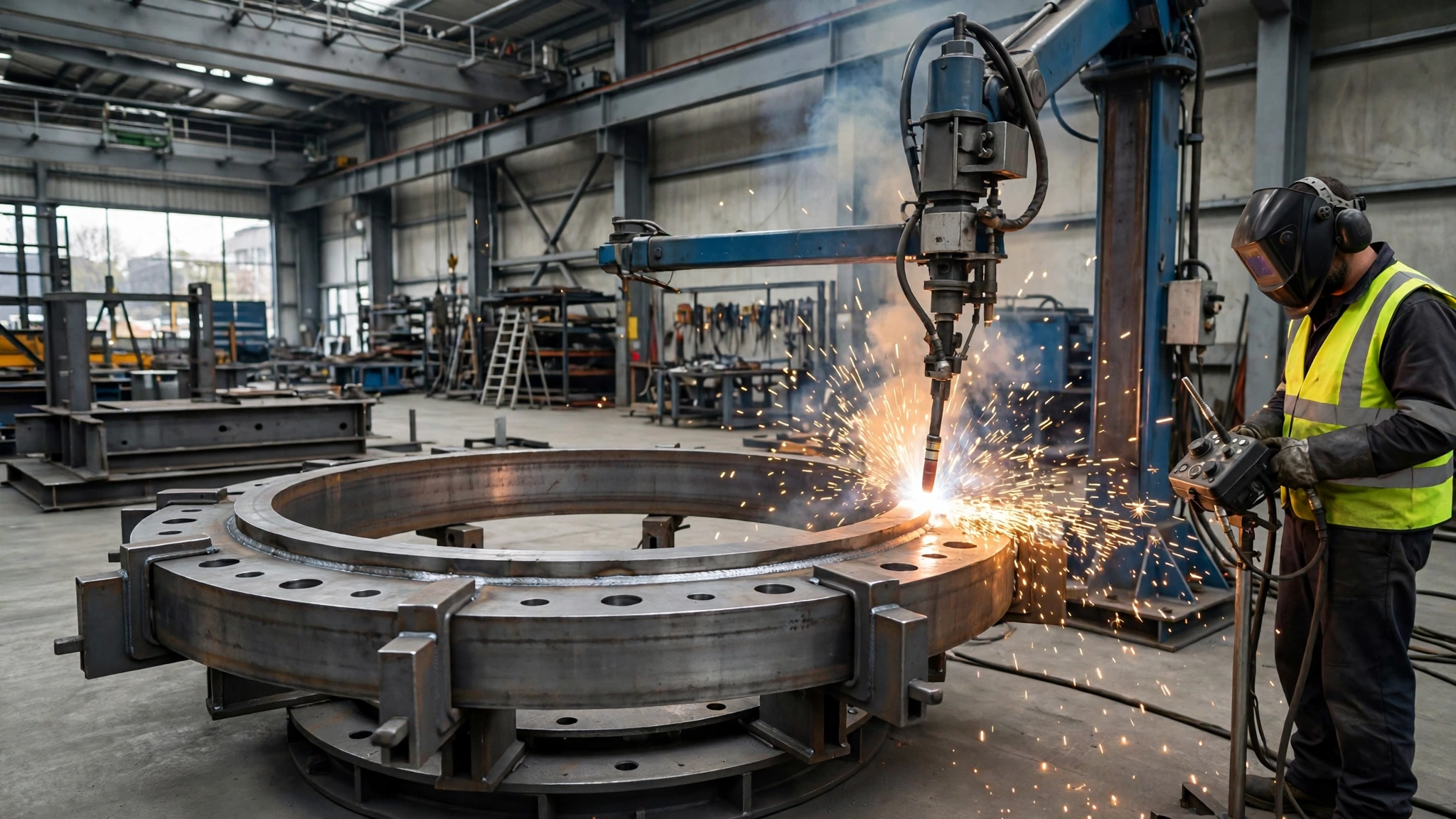
Picture the two machines side by side. A floor turntable is a powered rotary table on a fixed base. The workpiece is set down on the table face — by crane, from above — clamped to T-slots or a tapped grid, and the table turns about a vertical axis, like a lazy Susan built for tonnes. The weld is made from above while the part rotates beneath the torch. There is no tilt and no lift.
A welding positioner is a different machine. Its table or faceplate is carried on a tilt trunnion, so the whole table can be tipped — on MISA’s published project machines, typically 0–120 degrees — while also rotating 360 degrees. Some designs add hydraulic lift; one MISA project machine, a 3-tonne hydraulic positioner supplied to a heat-transfer equipment maker in Camden, New Jersey, combined 0–360 degree rotation with 0–120 degree tilt and 0–800 mm of lift. Headstock-and-tailstock positioners grip a long part between a driven headstock and a tailstock, and L-type positioners carry the table on an L-shaped arm so bulky weldments such as excavator buckets can be turned end over end. See MISA’s welding positioner range.
The confusion is understandable because the two machines share a vocabulary — both have a table, both rotate, both are quoted in tonnes — and because small bench-top units blur the line. The test that separates them takes ten seconds: ask whether the machine can tip the workpiece. If it cannot, it is a turntable, whatever the brochure calls it. If it can, it is a positioner, and the tilt range, not the tonnage, is the specification that decides whether your joints can be welded flat.
A third family, the welding rotator (welding rotator range), carries a cylindrical shell on driven rollers and turns it about a horizontal axis by friction — fast to load, but only for round cylindrical work.
Turntable vs Positioner vs Rotator: The Quick Comparison
Before choosing between any two machines, it helps to see all three holding families in one place, because the real decision is often “which family?” rather than “which model?”. Read the “hard limit” column first — it is the fastest way to eliminate the wrong machine.
| Machine | Powered axes | Load path | How the work is held | Best work | Hard limit |
|---|---|---|---|---|---|
| Floor turntable | Rotation only, vertical axis | Straight down through the table into a slewing ring and the floor | Set on a face and clamped to the table | Discs, rings, flanges, vessel heads, tank bottoms | No tilt: any joint that needs tipping cannot be welded flat |
| Tilt-and-rotate positioner | Rotation + tilt, often + lift | Through the table into a tilt trunnion; the load is cantilevered when tilted | Clamped to a tilting table, or gripped between headstock and tailstock | Weldments with seams on several faces, buckets, frames, pipe assemblies | Cantilever and tilt-torque limits cap heavy off-centre loads; tilt needs swing room |
| Welding rotator (turning rolls) | Rotation only, horizontal axis | Down through the shell wall onto rollers at two support points | Shell rests on rollers; rotation by friction, no fixture | Long cylinders: pipes, tank shells, pressure vessels, wind-tower sections | Needs a round, grippable cylindrical surface; cannot hold discs, heads or irregular shapes |
The buyer conclusion is that tonnage is the wrong first filter. A turntable wins on the load path: weight running straight down into a slewing ring is a simple structural problem, which is why very heavy flat work is an ordinary job for a turntable and a difficult one for a cantilevered positioner. A positioner wins on access: it alone can bring a seam on the side or underside of a weldment into the flat. And a rotator wins on loading speed for long cylinders, because there is nothing to clamp. Match the machine to the geometry and the joint first; then compare capacities.
Which Machine Fits Which Workpiece
The comparison above is general. The matrix below is specific: it maps the workpiece and the joint you actually have to the machine that fits, and says why. If your shop makes several of these parts, the matrix also shows why some shops end up owning both machines — MISA supplied exactly that combination, a 5-tonne welding positioner and a 10-tonne welding turntable, to a customer in Auckland, New Zealand, in 2019.
| Workpiece and joint | Floor turntable | Tilt-and-rotate positioner | Why |
|---|---|---|---|
| Vessel head or dished end, circumferential seam on the rim | Best choice | Works, but tilt is unused | The head sits on its face, the rim seam is horizontal, rotation brings the whole seam to the torch |
| Flange ring or annular plate, circumferential and radial seams | Best choice | Works, but tilt is unused | All joints lie in one plane; rotation alone presents every seam flat |
| Tank bottom or large flat plate assembly | Best choice | Poor choice | Thin plate needs support and clamping across the table; tilt would let it flex and move the gap |
| Pipe flange welded to a short pipe spool | Good choice | Best choice | A positioner can tilt the spool so the flange fillet is welded flat; a turntable welds it horizontal-vertical |
| Excavator bucket, structural frame or weldment with seams on many faces | Poor choice | Best choice | Each seam needs a different tilt angle to reach flat |
| Long cylindrical shell, circumferential and longitudinal seams | Poor choice | Poor choice | Use a rotator: the shell needs support at two points and friction drive, not a face or a grip |
| Heavy irregular fabrication with off-centre mass | Good choice if CG is centred | Check tilt torque carefully | A turntable takes the mass axially; a positioner must hold the same mass cantilevered through the tilt axis |
The buyer conclusion is straightforward: if every joint lies in the plane of the table face, buy the turntable and spend the saving on clamping, speed control and a manipulator. If joints lie on more than one plane, buy the positioner — its capacity will be set by tilt torque and eccentricity, not headline tonnage. If your work is long cylinders, look at rotators.
The Load Path: Why the Same Tonnage Is a Different Problem
Here is the engineering idea that makes the whole comparison click. On a turntable, the workpiece sits on a face and its mass runs axially — straight down — into a slewing ring or central bearing and then into the floor. There is no overhung moment from the mass itself. The only moment the bearing and drive must resist comes from eccentricity: the distance between the part’s centre of gravity and the rotation axis. That is why a very heavy part standing on a table is an ordinary structural problem, while the same mass hanging off the face of a headstock would be a different machine entirely.
On a positioner, the load path is harder: when the table tilts, the workpiece hangs off the tilt trunnion, and the drive must hold the full weight cantilevered. Tilt torque, not static capacity, becomes the limiting factor, growing with mass and with the centre of gravity’s distance from the tilt axis. That is why MISA’s project notes warn buyers to consider eccentricity and centre of gravity, and why its published positioner capacity range of 300 kg to 50,000 kg is a per-project specification.
Three numbers size either machine. Get all three before you ask for a price, because a quotation built on one of them is a guess.
| Number | What it is | How to get it | What goes wrong if it is ignored |
|---|---|---|---|
| Mass including fixture and clamps | Total static load on the table | Weigh the part, or calculate from the drawing; add fixture, clamps and backing bars | Overload: frame deformation, drive damage, bearing failure, safety risk |
| Centre-of-gravity offset from the rotation axis (eccentricity) | The distance the CG sits from the axis, in mm | Mark the CG on the general arrangement drawing — not the geometric centre | Eccentric moment overloads the slewing ring and drive even when the mass is within rating; the table runs unevenly and seam height varies as it turns |
| Swept diameter | Largest dimension of the part plus clamp and fixture overhang, in mm | Measure the longest diagonal of the part as clamped, including anything that sticks out | The part swings into the manipulator column, a wall, a neighbouring bay or a walkway; the cell cannot be used at full rotation |
The buyer conclusion is that the second row — eccentricity — is the one most often missed, and the one that causes the most expensive failures. A centred 12-tonne head is a 12-tonne job; the same head with its centre of gravity 400 mm off the axis adds a 4.8 tonne-metre moment trying to tip the table. Mark the centre of gravity on the drawing and send it with the enquiry; any supplier who sizes a machine without it is guessing.
Worked Examples
The numbers below are examples with stated assumptions, not MISA specifications. They show how the sizing logic works so you can repeat it with your own figures.
Example A — eccentric moment. Assume a vessel head weighing 12 t, clamped to a turntable with its centre of gravity 400 mm (0.4 m) from the rotation axis. Eccentric moment = mass × offset = 12 t × 0.4 m = 4.8 tonne-metres. Centre the same head to a 50 mm offset and the moment falls to 0.6 tonne-metres. The mass never changed; the load on the bearing changed eightfold. Centring the part — or adding counterweight where it is asymmetric — is a sizing action, not housekeeping. At larger scale, a published illustration shows a 380 t vessel section with its centre of gravity 600 mm off axis putting 228 tonne-metres into the bearing.
Example B — rotation speed. Assume a flange ring 3,000 mm in diameter with a circumferential seam, welded by MIG/MAG at a target travel speed of 400 mm/min. The circumference is π × 3,000 mm ≈ 9,425 mm, so one revolution takes about 23.6 minutes and the table must turn at roughly 0.042 rpm. Welding rotation is measured in fractions of an rpm, and the speed must be steady and finely adjustable, because travel speed at the joint is a welding-procedure variable. A drive whose slowest speed is too fast, or whose speed steps are too coarse, cannot hold a qualified procedure on a large-diameter seam.
Turntable + Manipulator: The Cell, Not Just the Table
A turntable is often half a welding cell, not a standalone answer. The other half is the machine that holds the torch: a column-and-boom welding manipulator. In the standard heavy-fabrication cell, the workpiece rotates on the turntable at a controlled speed while the manipulator holds the welding head stationary above the seam. The manipulator’s vertical stroke sets which seam heights it can reach, and its horizontal stroke sets how far across the table face it can work. MISA’s published manipulator ranges are a vertical stroke of 2 m to 6 m or more and a horizontal stroke of 2 m to 8 m or more, with SAW, MIG/MAG, TIG and FCAW head packages. See the welding manipulator range.
The table below maps the common cell layouts: the turntable supplies rotation, the manipulator supplies torch position, and together they cover seams that neither machine covers alone.
| Cell layout | Seams it welds | Typical process | Watch out for |
|---|---|---|---|
| Turntable + fixed column-and-boom, torch above the seam | Circumferential seams on heads, rings and flanges | SAW or MIG/MAG | Boom reach must cover the seam radius; the column must clear the swept diameter |
| Turntable + travelling column-and-boom on rails | Circumferential seams on several table stations, or long radial seams | SAW or MIG/MAG | Rail travel and floor space; one manipulator serving two turntables needs interlocked scheduling |
| Turntable + manual welder at a fixed station | Circumferential and radial seams, small batches, varied parts | MIG/MAG or TIG | Guarding around the rotating table; the welder must not reach across the swing zone |
| Positioner + column-and-boom | Multi-plane seams on weldments, tilted into flat | SAW, MIG/MAG or TIG | Tilt clearance: the part’s swing when tilted is larger than its footprint on the table |
| Turntable + positioner in the same bay | Flat disc/ring work on the turntable; multi-plane work on the positioner | As suited to each part | Floor space and crane sharing; the Auckland project paired a 10 t turntable with a 5 t positioner for this reason |
The buyer conclusion is to specify the cell, not the machine. A turntable bought without checking boom reach leaves the outer seams unwelded; a manipulator bought without checking the swept diameter collides with the part on its first rotation. Send the part drawing, seam list and cell layout together, and ask for the combination to be confirmed as a system.
Specification and Total Cost: Where the Hidden Money Sits
The purchase price is the visible part of the cost. The table below lists the items that decide the real cost of owning either machine, and what each one costs if it is ignored.
| Item to check | Floor turntable | Tilt-and-rotate positioner | Cost if ignored |
|---|---|---|---|
| Foundation and floor | Point loads into the floor; heavy models need a fixed concrete foundation with anchor bolts to the manufacturer’s drawings | Same, plus tilt-reaction loads when tipped | A cracked or deflecting floor, a table that runs out of flat, or a retrofit foundation costing more than the machine |
| Swept diameter and swing zone | Largest part dimension plus clamp overhang, at floor level | Larger: the part sweeps a bigger envelope when tilted than when flat | Cell layout rework, or a machine that cannot rotate fully |
| Table flatness and clamping | Table must stay flat under load; clamp close to the seam, not only at four points | Same, plus the fixture must hold the part securely at tilt | A seam gap that opens and closes as the table turns; arc-length variation; rework on TIG roots |
| Rotation speed range and control | Fine, stepless speed control down to a fraction of an rpm; VFD with pendant | Same, plus tilt speed control and holding brake | Travel speed outside the qualified welding procedure; welds that do not match the WPS |
| Weld-current return (earthing) | Slip ring or ground ring to carry weld current to the rotating part without a stray path through the bearings | Same requirement | Bearing damage from stray weld current; erratic arc |
| Guards, E-stop and interlocks | Barriers around the swing zone; emergency stop within reach | Same, plus tilt-motion interlocks | An operator in the swing zone of a multi-tonne rotating part; a reportable safety incident |
The buyer conclusion is that the foundation, swing zone and speed control are where these projects go over budget — not the machine itself. Price the foundation, guarding and manipulator interface in the same enquiry, and the quotation you compare will be the real one.
When Not to Use a Turntable
A turntable is the wrong machine whenever any of the following is true, and no accessory fixes it:
- Any joint needs tilt to reach the flat position. A longitudinal seam on a shell standing on a turntable stays in the vertical plane; it can only be welded horizontal-vertical, not flat. If your procedure needs flat position on that seam, buy a positioner.
- The work is a long cylinder. A pipe or shell has no flat face to sit on and nothing for the table to clamp. Use a rotator.
- The work must be gripped at both ends to stay true. Long, slender or flexible parts need headstock-and-tailstock support; a face-clamped table cannot control their axis.
- The centre of gravity cannot be brought inside the table. A tall, top-heavy or very asymmetric part whose centre of gravity sits outside the support span needs counterweight, outriggers or a different machine — a turntable with an overhanging load is a tipping risk.
- The floor cannot take the point loads. If the shop floor is a thin slab with no foundation provision and no budget to pour one, a heavy turntable is not a purchase; it is a civil works project with a machine attached.
A positioner is the wrong machine when the work is a heavy flat disc, ring or head that only ever needs rotation: you pay for tilt, lift and a cantilevered structure you will never use, and the tilt trunnion becomes the capacity limit where a turntable’s axial load path would have been simple. The honest answer for a mixed shop is often both machines — which is what the Auckland project did.
Common Buying Mistakes
- Choosing by rated tonnage only, ignoring centre of gravity and eccentricity. Mass, offset and the resulting moment decide the real load on the slewing ring and drive; ignoring them leads to uneven rotation, bearing damage, frame deformation, or a tipping risk.
- Buying a turntable for a joint that needs tilt. After delivery the buyer finds a seam can only be welded vertical or overhead, so the shop accepts lower quality, pays for rework, or buys a positioner anyway — the turntable becomes an expensive indexing table.
- Buying a positioner for heavy flat work that only needs rotation. The shop pays for tilt and lift it never uses, and the cantilevered tilt axis caps the load below what a turntable of the same price would carry — dearer and weaker for the job.
- Ignoring swept diameter and swing clearance. The part fits the table, then swings into the manipulator column, a wall or a walkway on its first rotation, forcing a cell rebuild or a permanent restriction that halves the machine’s usefulness.
- Ignoring the floor and foundation. The whole load goes into the floor at a handful of points, and heavy models need a fixed concrete foundation with anchor bolts to the manufacturer’s drawings. A deflecting slab tilts the table, moves the seam, and can crack — and the retrofit costs more than the saving made by skipping it.
- Clamping thin plate at four points only. A 3 m tank bottom clamped at four points flexes between the clamps as it turns, so the weld gap changes around the circumference — inconsistent fit-up, arc-length variation and rework. Clamp radially, close to the seam, with adjustable supports under the plate.
- Ignoring rotation-speed range and fine control. A drive whose slowest speed is too fast, or whose speed changes in coarse steps, cannot hold the travel speed the welding procedure requires. Welds drift outside the qualified procedure, and the shop either requalifies or accepts welds it cannot defend to an inspector.
- Ordering without a drawing, a joint list and a marked centre of gravity. The supplier sizes the machine on tonnage alone, and the machine that arrives is wrong for the eccentricity, swept diameter or joint positions — a return, a rebuild, or a machine worked around for its whole life.
- Forgetting the torch side. The holding machine is bought without the manipulator, torch package or weld-current return it needs, so the cell cannot weld on arrival and the missing half is ordered late, at a premium, without being checked against the swept diameter.
Buyer Checklist
- What are the workpiece dimensions, weight and centre of gravity? Weight alone does not size the machine. Dimensions set the table diameter and swept envelope; the centre of gravity sets the eccentric moment on the bearing and drive.
- What is the centre-of-gravity offset from the rotation axis, in mm? This number turns a mass into a moment. Without it, nobody can confirm the bearing, drive or foundation — send it marked on the drawing.
- What diameter table do you need, and how will the part be clamped? Table size, T-slots or a tapped grid, and the clamping plan decide whether the part can be held flat and securely — especially thin plate that flexes between clamps.
- List every joint, and state the weld position each joint needs. If every joint can be welded flat with the part horizontal, a turntable is enough. If any joint needs tilt to reach flat, that joint alone justifies a positioner.
- What is the weld process, and what travel speed does it need at the joint? SAW, MIG/MAG, TIG and FCAW need different travel speeds, and the rotation range must deliver the slowest and the fastest steadily.
- What rotation speed range and control do you need? Fine, stepless control down to a fraction of an rpm matters more than top speed. Ask for the minimum speed, the control type (pendant, foot switch, PLC) and whether rotation can be synchronised with the manipulator.
- What is the swept diameter, including clamps and fixture overhang? The machine needs clear floor space for the largest circle the part describes, not just its footprint when stationary.
- What is the floor construction, and can it take a foundation? Confirm slab thickness, load capacity and whether anchor bolts and a concrete foundation to the manufacturer’s drawings are possible — before ordering, not after delivery.
- How will the part be loaded, and what crane capacity is available? A turntable is loaded from above by crane; confirm the crane can reach the table, clear the manipulator, and handle the part plus its fixture.
- Will a manipulator be paired with it, and what reach and stroke are needed? The manipulator’s boom must reach the outermost seam radius and its column must clear the swept diameter; specify the cell as a system.
- What is the power supply and voltage on site? Drive and control ratings depend on the site supply; confirming it early avoids a transformer or supply upgrade after the machine arrives.
- What safety provisions are included — guards, emergency stop, interlocks? A multi-tonne part rotating at floor level needs a guarded swing zone and an emergency stop within reach; tilt motion on a positioner needs its own interlocks.
- What is the production target and duty cycle? Parts per week, seams per part and hours per day decide whether a manual pendant is enough or the cell needs PLC control — and they set the payback.
What to Send for a Quote
A supplier can only specify the right machine from real data. Send: workpiece drawings with dimensions, weight and the centre of gravity marked; the joint list with the weld position each joint needs; the weld process and travel speed range; the table diameter you need and how the part will be clamped; the production target in parts per week and the duty cycle; the manipulator you intend to pair with it, or ask MISA to propose the cell; the site power supply and voltage; floor construction and available space, including the swept diameter you can accommodate; crane capacity and loading method; and delivery, installation and training requirements. MISA specifies positioners and turntables per project — the published capacity range of 300 kg to 50,000 kg for positioners is a range of what has been supplied, not a catalogue promise. For project evidence of both machines working side by side, see MISA’s welding positioner projects.
Final Recommendation
If your work is discs, rings, flanges and vessel heads loaded from above and welded flat, buy the floor turntable — the simpler machine, the stronger load path, the cheaper answer — and paired with a column-and-boom manipulator it becomes a complete circumferential welding cell. If any joint needs tilt to reach flat, buy the positioner instead, sized on tilt torque and eccentricity rather than headline tonnage. If your work is long cylinders, buy neither and look at rotators. And if your shop does both kinds of work, budget for both machines: a turntable doing a positioner’s job, or a positioner doing a turntable’s job, is the most expensive option of all.
Send MISA the workpiece dimensions, weight, centre of gravity, joint list, weld process, production target and facility constraints, and ask for the holding machine — turntable, positioner, or the pair — specified as a system with the manipulator that will weld it.
Sources
- MISA welding positioner projects (Auckland 5 t positioner + 10 t turntable; Camden 3 t hydraulic positioner, rotation 0–360°, tilt 0–120°, lift 0–800 mm; Belfast L-type positioner) — https://weld-fab.com/welding-positioner-projects/
- Red-D-Arc, “Welding Automation: Arc Motion vs Work Motion” — welding positions (1G/1F flat, 2G/2F horizontal, 3G/3F vertical, 4G/4F overhead) and positioner types — https://blog.red-d-arc.com/welding-automation-arc-motion-vs-work-motion/
- Westermans, “Guide to Welding Automation” — positioners, turntables, rotators and column-and-boom combinations — https://www.westermans.com/knowledgehub/welding-automation-guide.aspx
- Desanee, “Floor table positioner FT3 for tank and part welding” — floor tables have no tilt and no lift; table flatness, slewing-ring stiffness and clamping close to the seam — https://www.desanee.com/articles/floor-table-positioner/?catid=10&Itemid=101
- Zaulux, “Welding Turntable or Welding Rotator for 500-Ton Workpieces?” — axial load path of turntables, eccentric moment (380 t at 600 mm offset = 228 tonne-metres), turntable limits — https://www.zaulux.com/blog/welding-turntable-vs-welding-rotator-500-ton/
MISA figures are published project figures; final values are specified per project.