Wind energy tower fabrication automation
Wind Tower Construction
MISA Manufacturing engineers automated welding, fit-up, rotation, and quality-control systems for high-volume wind tower production, helping fabricators meet demanding structural integrity, weld accuracy, and delivery requirements.
- Tower Height
- 50-120m
- Materials
- CS / Alloy
- Standards
- ASTM / EN
- Process
- SAW
Industry requirements
Wind towers demand structural integrity at industrial scale.
Wind tower structures support renewable energy assets exposed to severe dynamic loads, vibration, weather, and long service cycles. Tower sections are commonly fabricated from high-strength, corrosion-resistant carbon steel or alloy steel that complies with international specifications such as ASTM A572 and EN 10025.
Large structural geometry
Tower segments are large-diameter, heavy-wall structures that require controlled shell handling, concentric fit-up, and stable circumferential rotation throughout welding.
High weld precision
Internal and external circumferential welds, longitudinal seams, and flange welds must meet strict dimensional and metallurgical expectations.
Repeatable mass production
Global wind energy demand requires manufacturing systems that reduce manual intervention, keep welding parameters consistent, and support efficient takt time.
MISA automated welding solutions
Purpose-built systems for tower shells, foundations, seams, and flanges.
Wuxi Misa Welding Equipment Co., Ltd. provides customized automation packages for oversized and ultra-heavy tower components, combining heavy-duty rotation, hydraulic alignment, automated welding travel, and process integration.
Rotation Control
Dual-drive torque consistency
Weld Process
SAW-ready deep penetration
Wind tower automation package
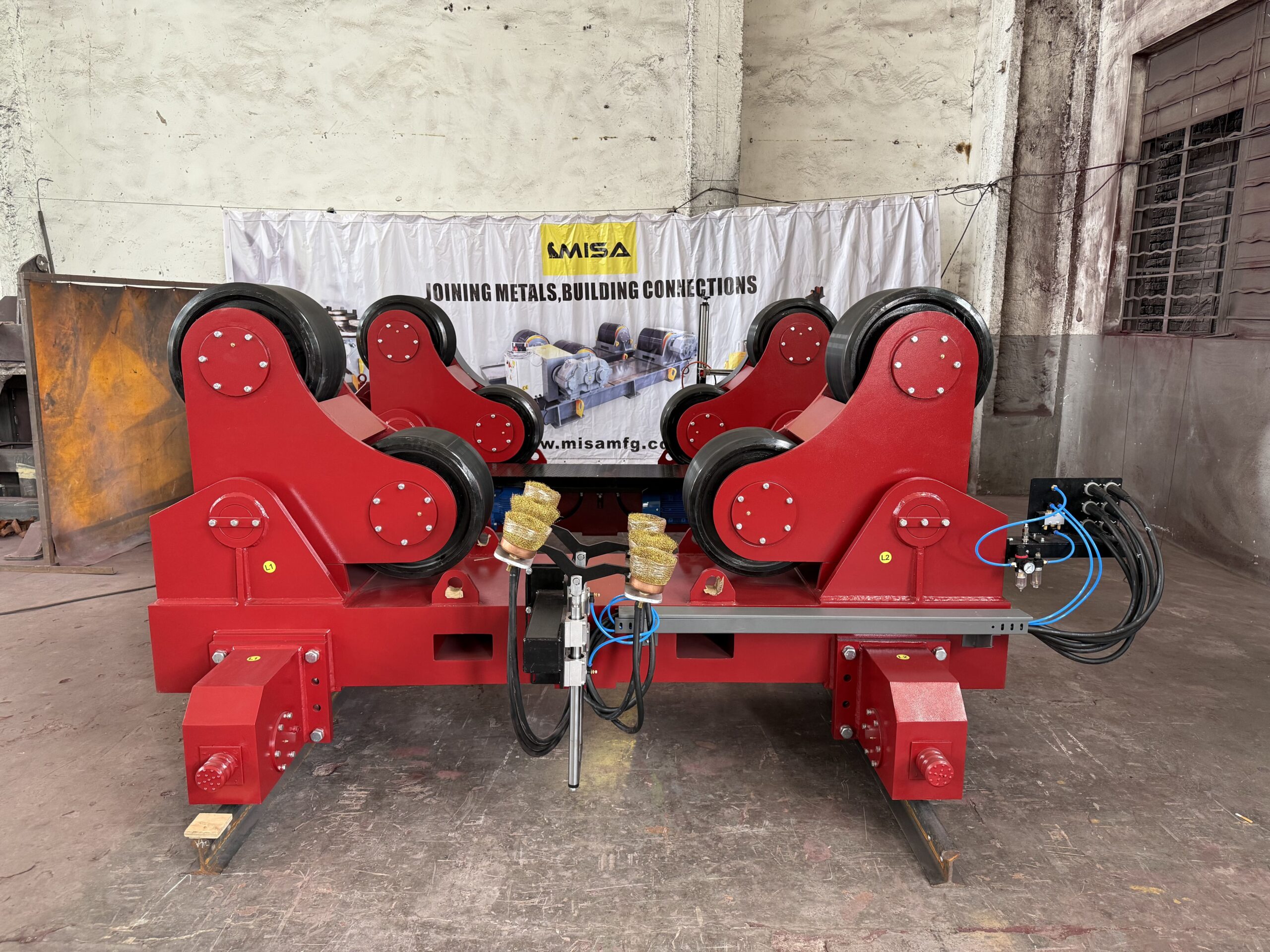
Heavy-duty self-aligning welding rotators
Dual-drive mechanisms maintain consistent torque and smooth rotation. Polyurethane rollers improve friction, wear resistance, and thermal stability while automatically adapting to different tower shell diameters.
Hydraulic fit-up rigs and growing lines
Multi-axis hydraulic adjustment and remote control support precise alignment of tower sections and foundation pipes without direct manual intervention around heavy components.
Column and boom welding manipulators
Integrated with rotators for continuous automated welding of internal and external circumferential welds, longitudinal seams, and flange welds using SAW and related heavy fabrication processes.
From shell fit-up to final weld
A coordinated production flow for heavy tower fabrication.
- Automatic diameter adaptation reduces manual setup time between shell sizes.
- Remote hydraulic alignment improves operator safety during large-section assembly.
- Manipulator and rotator synchronization supports consistent weld bead geometry across long production runs.
Quality control and automation
Built to reduce variability and support stricter weld acceptance.
MISA systems can integrate with non-destructive testing workflows and automated inspection platforms, helping manufacturers detect internal or surface defects while increasing process consistency across wind tower production.
NDT integration readiness
Equipment layouts can support automated ultrasonic testing robots and radiographic testing vision systems for weld verification against demanding safety requirements.
Lower rework and shorter cycles
Fully automated rotation and positioning coordination removes much of the instability of manual work, reducing repair rates and shortening production cycles.
Wind tower project pathway
Share your tower diameter, section weight, weld process, and production target.
MISA Manufacturing can recommend a wind tower automation route covering rotators, hydraulic growing lines, welding manipulators, SAW integration, and inspection-ready production planning.
Application-led configuration
Equipment selected around tower geometry, material grade, payload, and welding procedure.
Production efficiency
Automation reduces manual adjustment and supports stable throughput for growing wind energy demand.
Inspection-ready workflows
NDT-compatible layouts support UT and RT inspection paths for safety-critical weld verification.