Engineering guide
How Welding Automation Reduces Rework & Raises Output
See how stable positioning, repeatable motion, process control, and better handling can increase welding throughput while reducing defects and rework.
Format
Practical Guide
Focus
Engineering
Outcome
Better Selection
Overview
Built around real fabrication requirements.
In today’s date and time, welding automation is considered the future of work. From creating intricate and complex materials to the finishing assembly of a product, automation is not alien to those. The welding industry is one of the first industries that experienced and felt its overall effects.
Final equipment configuration is confirmed against the workpiece, welding process, production target, handling method, utilities, and workshop layout.
Enhanced weld quality and accuracy
Enhanced weld quality and accuracy
Increased productivity per welder
Increased productivity per welder
Lowered rework and scrap expenses
Lowered rework and scrap expenses
Minimized welder fatigue
Minimized welder fatigue
More efficient use of welding materials and consumables
More efficient use of welding materials and consumables
Expanded capacity for complex welding tasks
Expanded capacity for complex welding tasks
Technical reference
Confirm the specification before ordering.
Published values are selection guidance. MISA engineering confirms load, torque, center of gravity, speed, controls, safety, and interfaces for the final proposal.
| Configuration | Confirmed against workpiece drawings and production requirements |
|---|---|
| Control | Variable-speed operation with project-specific control options |
| Power supply | Configured for destination-country requirements |
| Documentation | Final technical proposal supplied before order confirmation |
Welding Automation: Boosting Productivity and Eliminating Rework
In today’s date and time, welding automation is considered the future of work. From creating intricate and complex materials to the finishing assembly of a product, automation is not alien to those. The welding industry is one of the first industries that experienced and felt its overall effects.
While there’s currently endless options for automated welding, we’ll give you few of the most crucial in this blog. We’ll talk about what welding automation really is, how it can help your overall processes, and what applications it has.
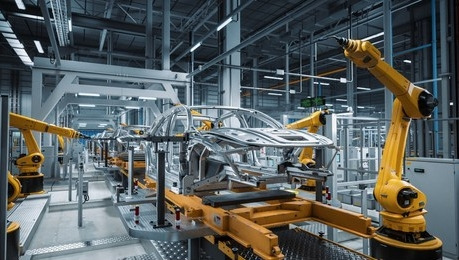
Understanding Welding Automation
From the term alone, it is the act of automating the welding process. Now, don’t get too excited, because just because it says “automated,” doesn’t mean you wouldn’t have to lift a finger. Welding automation can be a game-changer, whether it's fully automated or just partially so.
https://youtu.be/OkhfdXpBCK8?si=ZxRrrOxM6bduwuPH
The middle ground appears to be the sweet spot for most operations, with semi-automated welding systems providing the best value. Welding positioners, tractors, orbital welding systems, and others are just a few examples of the equipment that may assist your welders with excellent quality.
And that’s welding automation for you! Let’s tackle a bit more of its benefits and dive deep into the most important details about it.
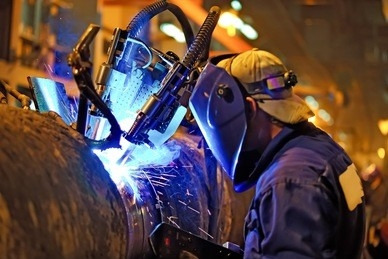
Boost and Enhance Productivity: The Advantages of Welding Automation
According to the Bureau of Labor Statistics, 560,000 workers get injured because of welding accidents–because they do manual work. When it comes to welding, the introduction of automation can change the landscape, offering a range of benefits that are hard to ignore.
-
Enhanced weld quality and accuracy
-
Increased productivity per welder
-
Lowered rework and scrap expenses
-
Minimized welder fatigue
-
More efficient use of welding materials and consumables
-
Expanded capacity for complex welding tasks
-
Reduced labor costs as one operator handles more output
-
Boosted profitability through cost savings
-
Optimized shop capacity and workflow efficiency
NOTE: These are just some of the advantages and benefits of automated welding. There are, of course, other benefits, and those benefits would be highly specific for the particular business or industry, which we’ll find more about later.
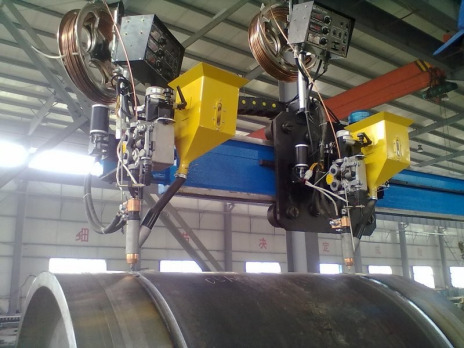
The Applications of Welding Automation Systems
https://youtu.be/zi_5Pr3HwpY?si=tHZRJP7aM14pYgBz
Over the years, many different classifications and kinds of welding automation systems have come into place. From the simplest of assisted welding machines to fully automated welding heads and moving parts, there’s literally a ton of opportunities in welding automation.
Now, let’s look at some of the known systems and how they’re used in different industries.
Welding Rotators and Turning Rolls: Essential Tools for Heavy-Duty Welding
Turning rolls and welding rotators are essential components of any automated welding setup, especially when working with big tanks, huge pressure vessels, or complex piping systems. These tools are made to effectively manage the weight and size of such equipment, which speeds up and greatly improves the safety of the welding process.
Not only is it dangerous, but using forklifts or other manual labor to rotate these enormous buildings is ineffective. Just by their sizes alone, you can already sense the danger and risks involving people and workers.
The more sensible option would be turning rolls. They have polyurethane (PU) roller wheels that come into direct touch with the vessel's sides and smoothly rotate it while welding or non-destructive testing (NDT) is being done.
The benefits of welding rotators don't stop at just welding. These can also be leveraged for other activities and tasks, such as spraying and maintaining. With the controlled rotation they offer, you can coat the entire surface of a vessel evenly, ensuring uniform finish while also maintaining safety.
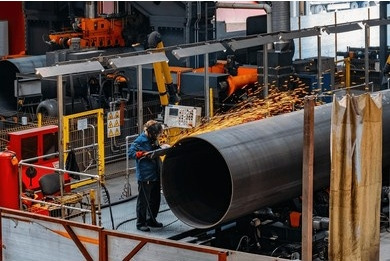
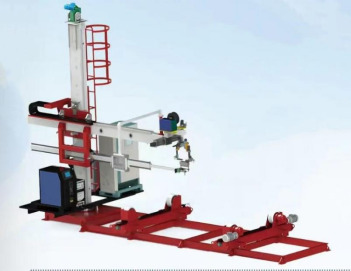
Column and Boom Welding Machines: The Backbone of Welding Automation
Column and boom welding machines are fundamental to modern welding automation, acting as the central pillar that supports and positions the welding head with precision.
Compared to traditional methods where welders actually do the maneuvering of the torch, these machines allow the welding head to remain stationary or move along the joint, greatly improving efficiency, accuracy, and safety in the welding process.
Moreover, the welder's responsibilities now include supervising the column and boom equipment's operation other than performing the actual welding. To add to the lessening the physical strain on the welder, this change raises productivity and improves the caliber of the welds produced.
In essence, column and boom welding manipulators are not just tools—they're the backbone of an automated welding setup, enabling operators to achieve consistent, high-quality results with greater efficiency and less physical effort.
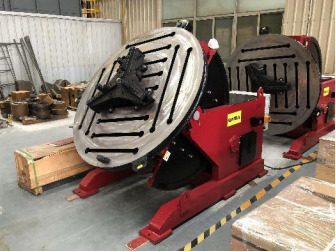
Welding Positioners: Enhancing Precision and Efficiency in Welding Operations
Last but most definitely not least are weld positioners. Welding positioners are essential tools that bring a new level of precision and efficiency to the welding process by automating the rotation and movement of the workpiece.
In addition to improving weld uniformity, positioners also contribute to the overall efficiency of the welding process. By automating the movement of the workpiece, they reduce the physical strain on the welder and minimize the chances of errors.
Their overall versatility in varied applications and their capacity to handle a wide range of workpiece sizes and weights make them indispensable. And when I say indispensable, I mean for any welding operation that strives for accuracy, consistency, and efficiency.
Order World-Class Quality Welding Automation Solutions From Misa Welding Co., Ltd.
From your typical welding rotator to CNC flame plasma cutting machines, you can count on Misa Welding Co., Ltd. to help you with the automation you’re looking for in your processes.
With a 3,000+ square meter working area, we’re sure that whatever you need has space in our workshop. Our experience and full understanding of the impact of welding and the welding industry alone makes us a permanent solution to most industry challenges.
Misa Welding Co., Ltd. has everything you need from welding manipulators, welding positioners, welding rotators, welding chucks, and many more!
Reach out to us today and we’ll get a free quote over! Be where you want to be in your business with Misa Welding Co., Ltd. Experience world-class-quality without going out of budget!
Frequently asked questions
Questions to resolve before quotation.
How should this how welding automation reduces rework & raises output guidance be used?
Use it to prepare technical questions and compare options, then confirm the final configuration against your drawings, workpiece data, process, and production goals.
Which project details affect equipment selection most?
Weight, dimensions, center of gravity, weld joint, process, rotation speed, duty cycle, handling method, utilities, and workshop layout are the main inputs.
Can MISA review a project before quotation?
Yes. Send the workpiece drawing and production requirements so the engineering team can recommend a practical automation route.
Start with your workpiece
Send the drawing, load, process, and production goal.
MISA engineering will review the application and recommend a practical automation route without changing the core requirement.