Ask a welding equipment supplier how much automation costs and you will usually get a price range so wide it is useless, a request to “send your drawings”, or a confident payback claim — “pays for itself in 18 months” — with no numbers behind it. None helps a fabrication manager justifying capital spending to finance.
This article gives you the method for producing your own number, honestly. There is no published MISA price list here, and inventing prices would be worse than useless: a rotator cell is sized around your workpiece, seam list, power supply and floor, so any price quoted without that data is a guess. Instead you will find the full cost model — what a cell costs to buy, install and run, what it saves per seam, a worked payback example with every assumption stated, the hidden costs, and the cases where automation does not pay.
Short Answer
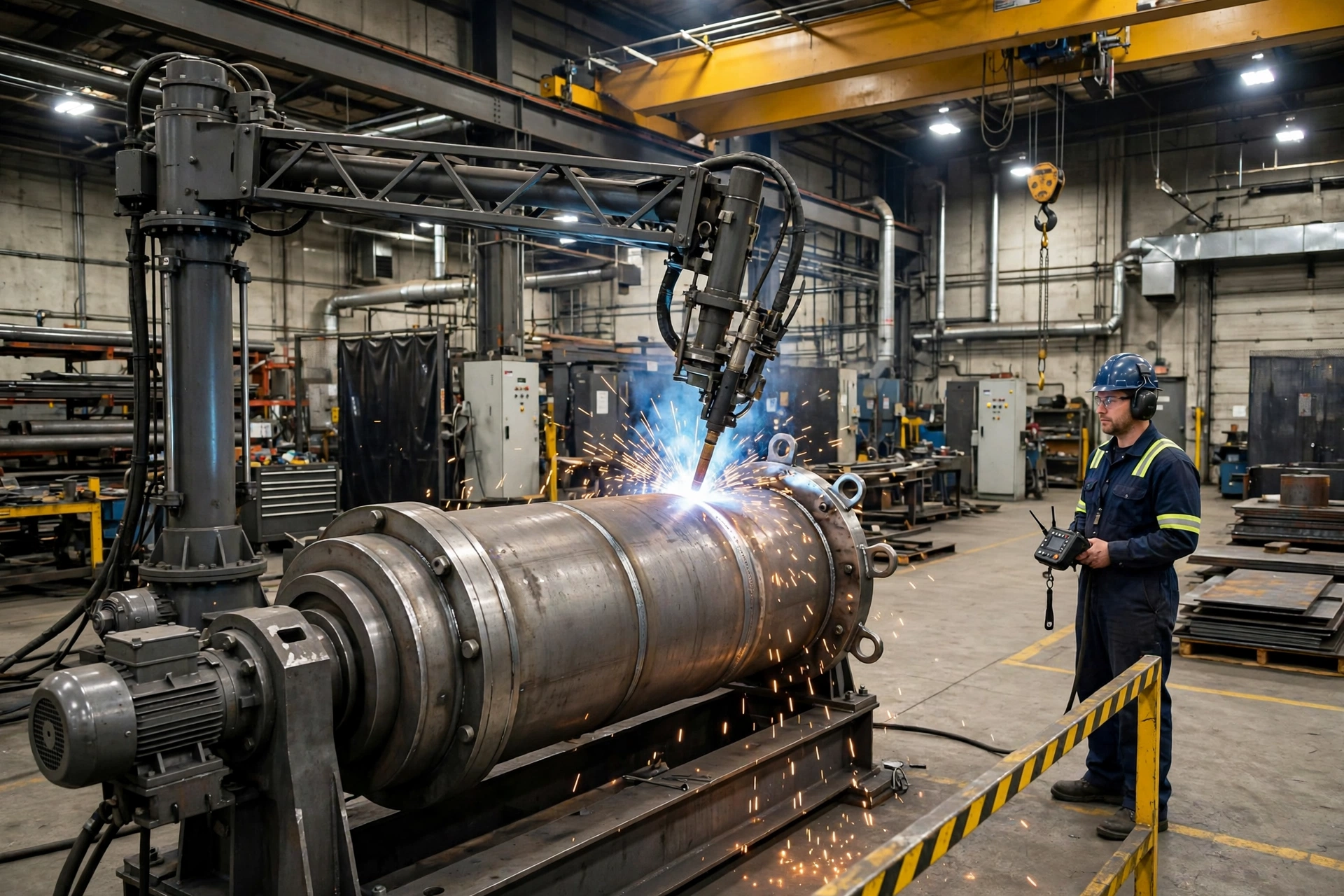
A welding rotator cell — a welding rotator turning the workpiece, paired with a column-and-boom welding manipulator carrying the torch — costs far more than its quotation price and pays back far faster than its purchase price suggests, provided the work is right for it. The quotation covers the machine; the real cost also includes freight, foundation or rails, power work, installation, commissioning, training, spares, and flux and wire handling. The real saving is cost per seam — the labour, crane time and rework that disappear when the arc stays on and the workpiece turns itself.
In the worked example below — 10 circumferential seams per week, 48 weeks per year, at example rates of USD 45 per welder-hour and USD 60 per crane-hour — a cell saving USD 195 per seam pays back an example installed cost of USD 180,000 in about 1.9 years (~23 months). That is an example, not a guarantee or a MISA price: halve the volume to 5 seams/week and payback takes about 3.8 years; double it to 20 and it falls to about 1.0 year. Volume, not the machine, is the dominant variable. Repetitive cylindrical work — vessels, tanks, pipe spools, wind towers — is where a rotator cell earns its keep.
Why This Topic Matters
Welding automation is usually sold on productivity, and productivity is usually described in the wrong unit. Nobody is paid per hour of machine ownership; the shop is paid per finished, inspected, delivered seam. Everything that matters to the cost of that seam happens around the arc, not only in it.
Weld quality and rework. A manual welder on a large vessel works in changing positions as the seam moves around the shell; travel speed, torch angle and arc length drift as the welder tires, producing defects that only show up at non-destructive testing (NDT), when the seam is complete. A failed seam is excavated, re-welded and re-inspected: the shop pays for it twice. TWI lists joint preparation, positioning, cleaning, post-weld heat treatment, NDT and repairs as costs directly affected by welding decisions, over and above depositing weld metal. A rotator holds the weld flat at constant speed; a manipulator holds torch distance and travel speed constant.
Cycle time and arc-on time. The key number in welding economics is the operating factor (duty cycle, or arc-on time): the share of working time the arc is actually burning. TWI publishes typical duty cycles of 30–45% for manual MIG/MAG, 80–90% for mechanised MIG/MAG, and 80–95% for submerged arc welding (SAW). The rest goes to positioning, electrode changes, cleaning, crane waiting and breaks. That gap is the case for automation: a mechanised process may not weld faster per minute, but it spends far more of the hour welding. TWI cautions that for one-offs, setting up a mechanised system can take longer than welding manually — judge the whole cycle, not just arc time.
Labour, crane waiting and safety. Labour is the largest variable cost in welding, and skilled welders are scarce. A rotator cell changes the welder’s job: one operator supervises the cell, loads and monitors the weld pool. In a heavy shop the crane is often the real bottleneck — every turn of a vessel waits for the crane, the slinger, and every other job in the bay. A rotator with a powered travel trolley moves a vessel along rails without a lift. Remote control — wired pendant (25 ft / 7.6 m), wireless pendant (up to 300 ft / 90 m), or foot switch — lets the operator stand clear of the load.
Technical Background: What Drives Cost per Seam
Cost per seam is the only figure that lets you compare manual welding, a rotator alone, and a full automated cell on equal terms. It has five components, and only one of them is the price of wire.
1. Arc-on time. The time the arc is burning, set by seam length, passes, joint volume and travel speed. A mechanised process sustains a higher duty cycle, and SAW deposits metal fast on thick sections — but arc-on time is usually the smallest part of total time per seam in manual work.
2. Positioning and crane time. Loading, aligning, turning between passes, moving to the next seam, unloading. In manual work this is crane time plus waiting; on a rotator the vessel is loaded once and turned by friction drive, or moved on rails without a lift.
3. Fit-up, cleaning and dressing. Joint preparation, tacking, cleaning between passes, slag removal. Automation does not remove fit-up — a mechanised torch follows a programmed path and cannot improvise around a gap, so shops that automate without improving fit-up often see rework rise first.
4. Inspection and rework. Visual inspection, NDT, and repairing what fails. A failed seam costs excavation, re-weld, re-inspection and delay. Cutting the failure rate from 8% to 3% is worth more per seam than a small speed increase, because a repair is paid for twice.
5. Consumables and energy. Wire, flux, shielding gas and power — the most visible costs and usually the smallest. TWI notes SAW flux use is approximately 1 kg per 1 kg of deposited metal, so integrated flux recovery is a running-cost decision on SAW work. MISA equipment is configurable for 110–600 V; the power cost is in the supply and cabling.
Two points shape every number that follows. First, duty cycle matters as much as deposition rate: 5 kg/h at 30% arc-on time is 1.5 kg per production hour; at 60% it is 3.0 kg. Second, the workpiece decides the equipment: geometry, weight and centre of gravity, torque and eccentricity, diameter range, rotation speed, process and joint type, stroke and reach, power and voltage, control and synchronisation, safety, floor space and crane access, and duty cycle must all be checked first. A 20-tonne rotator does not automatically handle every 20-tonne vessel — diameter sets wheel spacing, centre of gravity sets torque and tipping risk, and eccentricity can stall a drive that is fine on a balanced shell.
MISA states on its rotator page that “continuous arc operation can improve production efficiency by 30% to 40%”. That is a MISA claim, not an independent measurement, to be tested against your own cycle times. The worked example’s 40% reduction in time per seam (5.0 to 3.0 hours) sits at the top of that range, so it is an optimistic case, not a conservative one.
Main Comparison: Manual vs Semi-Automatic Rotator vs Automated Cell
Before comparing prices, compare what each step of automation actually removes from the cost per seam. A rotator alone and a rotator-plus-manipulator cell remove different costs, and buying the wrong one leaves your biggest cost line untouched. Duty factors below are TWI’s published figures.
| Route | Arc-on / duty factor (typical) | Positioning & crane per seam | Labour per seam | Weld consistency / rework tendency | Best for |
|---|---|---|---|---|---|
| Manual welding, crane positioning | 30–45% (manual MIG/MAG, TWI) | High: crane lift for every turn; waiting for crane and slinger | High: welder + helper, full shift in changing positions | Variable: speed, angle and heat input drift with fatigue | One-offs, repairs, asymmetric work, site work |
| Semi-automatic: rotator + manual torch | 30–45% arc-on, far less arc-off waiting | Low: loaded once, turned by friction drive; trolley moves it on rails | Medium: welder guides the torch, but works flat throughout | Better: constant rotation, flat position, stable heat input | Repetitive cylindrical seams where welder skill is the value |
| Automated cell: rotator + manipulator, PLC synchronised | 80–95% (SAW, TWI); 80–90% (mechanised MIG/MAG, TWI) | Very low: no crane lift between passes; torch travels to the joint | Low: one operator supervises and monitors | Most consistent: constant speed and torch distance, stored parameters | Repetitive cylindrical seams at steady volume: vessels, tanks, pipe, wind towers |
The buyer conclusion is straightforward. The rotator alone buys positioning time: it removes crane waiting and lets the welder work flat, but the weld still depends on the welder’s hand. Only the full cell buys consistent travel speed and torch position — and that consistency, not raw speed, cuts NDT failures and rework. So price the step that removes your biggest cost: crane waiting points to a rotator alone; rework points to the manipulator and its PLC synchronisation; fit-up problems point to fit-up discipline first, because no cell fixes that. A manipulator follows a programmed path, while a manual welder adjusts to a gap — on inconsistently prepared joints, the cell produces consistent welds that NDT will reject.
Cost Breakdown: Where the Money Goes per Seam
This table breaks cost per seam into its components at the worked-example rates (USD 45/welder-hour, USD 60/crane-hour, both examples). The point is the shape of the costs: change the rates to your own and the shape stays the same.
| Cost driver | What it includes | Manual (example, per seam) | Automated cell (example, per seam) | Who controls it |
|---|---|---|---|---|
| Welder / operator labour | Arc time, positioning, fit-up, cleaning, waiting | 5.0 h × USD 45 = USD 225 | 3.0 h × USD 45 = USD 135 | Shop: volume, fit-up, layout |
| Crane time | Lifts, turns, moves, waiting for crane | 1.5 h × USD 60 = USD 90 | 0.25 h × USD 60 = USD 15 | Rotator turning and rail travel replace lifts |
| Rework / NDT failure (expected value) | Excavation, re-weld, re-inspection, at example USD 600 per failed seam | 8% × USD 600 = USD 48 | 3% × USD 600 = USD 18 | Procedure, fit-up, heat-input consistency |
| Consumables (wire, flux, gas) | Filler metal, SAW flux (~1 kg per 1 kg deposited, TWI), gas | USD 25 | USD 22 | Process choice, flux recovery |
| Power and cell running cost | Electricity, wear items, routine maintenance share | USD 5 | USD 8 | Duty cycle, maintenance regime |
| Total cost per seam (example) | USD 393 | USD 198 |
The buyer conclusion is in the shape of the table. Wire, flux and gas — the costs buyers most often ask about — are the smallest lines, at USD 22–25 per seam. Labour, crane time and rework are USD 368 of the USD 393 manual cost per seam. A cheaper machine that leaves those three lines untouched is a false economy. Measure your own time per seam, split into arc-on, positioning, fit-up and rework, before you believe any payback figure — including the one in this article.
Worked Payback Example
Every assumption is stated below, every rate is labelled as an example, and the result is an example — not a MISA ROI guarantee and not a price. Substitute your own numbers and the method still works.
Assumptions (all examples — substitute your own)
- Shop and volume: Vessel shop, circumferential seams on cylindrical shells: 10 seams/week, 48 weeks/year = 480 seams/year.
- Labour rate (example): USD 45 per welder-hour, fully loaded.
- Crane rate (example): USD 60 per crane-hour, including operator and opportunity cost.
- Manual route, per seam: 5.0 hours of welder time (2.0 arc-on, 2.0 positioning/crane waiting, 1.0 fit-up and cleaning) and 1.5 hours of crane time.
- Automated cell, per seam: 3.0 hours of operator time (2.0 arc-on, 0.5 positioning/loading, 0.5 fit-up and monitoring) and 0.25 hours of crane time (loading/unloading only).
- Rework (example): NDT failure rate 8% manually, 3% automated. Cost per failed seam: USD 600 (example) for excavation, re-weld, re-inspection and delay.
- Consumables and power (example): USD 30 per seam in both routes — taken as equal, so they cancel out of the saving.
- Total installed cell cost (example): USD 180,000 — an example budget figure including freight, foundation/rails, power work, installation, commissioning, training and spares. It is NOT a MISA price; MISA prices are quoted per project.
- Excluded: Cost of finance, depreciation and tax, floor-space cost, and throughput value (extra seams the freed capacity could produce). Excluding throughput value makes the example conservative.
Step-by-step maths
| Line | Calculation (example rates) | Annual effect |
|---|---|---|
| Labour saving per seam | (5.0 h − 3.0 h) × USD 45/h = USD 90 per seam | 480 seams × USD 90 = USD 43,200/year |
| Crane saving per seam | (1.5 h − 0.25 h) × USD 60/h = USD 75 per seam | 480 seams × USD 75 = USD 36,000/year |
| Rework saving per seam | (8% − 3%) × USD 600 = USD 30 per seam | 480 seams × USD 30 = USD 14,400/year |
| Total saving per seam | USD 90 + USD 75 + USD 30 = USD 195 per seam | USD 93,600/year |
| Total installed cost (example) | USD 180,000 | — |
| Simple payback | USD 180,000 ÷ USD 93,600/year = 1.9 years (≈23 months) | — |
The example pays back in about 1.9 years. First, labour is the largest saving (USD 43,200/year), but crane time is close behind (USD 36,000/year) — where the crane is the bottleneck, crane saving alone can justify the cell. Second, rework saving (USD 14,400/year) is the smallest line but the most sensitive: at a 15% manual failure rate rather than 8%, it roughly triples. Third, the example holds arc-on time constant at 2.0 hours per seam in both routes. Higher SAW deposition rates or a second shift would grow the saving, but this article does not claim those gains — they depend on your procedure qualification and order book.
Sensitivity — what changes the payback
Payback is most sensitive to volume, then to saving per seam, then to installed cost. Varying one factor at a time from the base case (10 seams/week, USD 195 saving per seam, USD 180,000 installed cost, payback 1.9 years):
- Volume 5 seams/week (240/year): saving USD 46,800/year; payback ≈3.8 years. Volume 20/week (960/year): saving USD 187,200/year; payback ≈1.0 year.
- Saving USD 120/seam: payback ≈3.1 years. Saving USD 280/seam: payback ≈1.3 years.
- Installed cost USD 250,000: payback ≈2.7 years. Installed cost USD 120,000: payback ≈1.3 years.
The practical rule: below about 5 repetitive cylindrical seams per week, a full cell is hard to justify on labour and crane saving alone — consider a rotator alone. At 10 or more per week, the cell is usually the cheapest way to produce them, and every month of delay costs roughly USD 7,800 in foregone saving at the example rates.
Application Matrix: What Pays Back Fast vs Slowly
The same cell, at the same price, can pay back in a year or never, depending entirely on the work put through it.
| Work profile | Volume | Why it pays (or does not) | Expected payback | Recommended route |
|---|---|---|---|---|
| Repetitive cylindrical vessels / tanks, same diameter range | 10+ seams/week, steady | Set-up spread over many identical seams; crane freed | Fast: ~1–2 years | Full cell: rotator + manipulator, PLC synchronised |
| Pipe spools / wind tower sections, similar diameters | 10+ seams/week, batch | Same joint repeated; fit-up standardised; trolley moves work without crane | Fast: ~1–2 years | Full cell or rotator + manipulator with rail travel |
| Mixed diameters, moderate volume, cylindrical work | 5–10 seams/week | Self-aligning rotator (MSAR) adapts without manual adjustment | Medium: ~2–4 years | Self-aligning rotator first; add manipulator later |
| Pressure vessels, low volume, high rework cost (code work, thick section, SAW) | 3–5 seams/week | Rework saving dominates | Medium: ~2–4 years, driven by quality | Rotator + manipulator with SAW and flux recovery |
| One-off asymmetric fabrications, brackets, frames, nozzles | Low, highly variable | Rotator cannot hold the work; set-up exceeds welding time | Slow or never: 5+ years | Welding positioner (headstock-tailstock / L-type) or manual |
| Site / field work, repairs, shutdowns | Irregular | Cell cannot be moved to the work | No payback | Manual / portable equipment |
Payback is a property of the work, not of the machine: two shops buying the identical cell can have paybacks three years apart because one welds the same 3,000 mm shell fifty times and the other welds a different one-off every week. Before you ask for a price, count your seams — how many per week, what diameter range, how many passes, how similar they are. If you cannot answer that, you are not ready for a quotation.
MISA’s project history illustrates the fast-payback end of the matrix — a 50-tonne fit-up growing line in Rotterdam, 80/150-tonne self-aligning rotators in Gemlik, Turkey, and 20–200-tonne conventional rotators in Dallas, TX — all repetitive, large-diameter cylindrical work at volume. They are evidence of past supply, not a promise about your payback.
Hidden Costs: What Does Not Appear in a Quotation
A quotation is the cost of the machine leaving the factory. A working cell in your bay costs more, and every item on that longer list has surprised a buyer who budgeted only for the quotation. Budget the total installed cost before seeking approval.
- Freight, packing and import. Sea freight, packing, customs, duties and inland transport are routinely 5–15% of the equipment price, often quoted separately. Ask whether the quotation is ex-works, FOB, or delivered to site.
- Foundation, floor and rails. A fixed manipulator needs an anchored foundation; a travelling one needs level rails; a rotator under a 150-tonne vessel needs a floor that carries the load. Civil work is site-specific and almost never in the equipment quotation — price it from the layout drawing first.
- Power and electrical work. The cell may need a new supply, cabling, or adaptation to local voltage and safety rules. MISA equipment is configurable from 110 V to 600 V, but cabling and earthing are your electrician’s work unless the contract says otherwise.
- Installation and commissioning. Some suppliers include it; others charge engineer time, travel, board and lodging. MISA’s projects show engineers travelling to Rotterdam, Gemlik, Dallas and Brisbane for several days. Ask who pays for travel and how many days are included.
- Training. A cell run by an untrained operator produces bad welds at high speed. Allow for operator and maintenance training plus supervised production on real work.
- Spares and wear items. Wheels wear; pendants get dropped; tips, nozzles and drive parts are consumable. An initial spares holding is the difference between a one-day stop and a three-week wait.
- Flux and wire handling (SAW). SAW uses roughly 1 kg of flux per 1 kg of deposited metal (TWI). Storage, drying, handling and disposal are running costs; a recovery system makes them continuous.
- Procedure qualification and trials. Procedures must be qualified for your joints, materials and thicknesses, with trial seams inspected before production.
- Safety guarding. Fencing, interlocks, emergency stops and exclusion zones around a turning 150-tonne vessel are not optional. Confirm what is included.
- Maintenance and downtime. Budget an annual allowance (a common planning figure is 2–4% of installed cost per year — an example, not a MISA figure) and a realistic availability figure: a cell available 90% of the time produces 10% fewer seams than assumed.
- Floor space. A cell, its rails, loading area and exclusion zone occupy a bay that cannot hold other work.
- Currency, lead time and delay. Equipment is made to order, with lead times in weeks (MISA examples show 25–50 days of production before shipment).
Add the hidden costs to the quotation before calculating payback, not after. In the worked example, USD 180,000 is already a total installed cost. If your quotation is USD 120,000 for equipment alone, installed cost may be USD 150,000–180,000 — and payback should be calculated on the larger number.
When Automation Does NOT Pay
A rotator cell does not pay — or pays so slowly that the capital is better used elsewhere — in these cases:
- One-off, asymmetric work. Every workpiece differs, so set-up eats the saving — TWI warns that preparing a mechanised system for one-offs can take longer than welding manually. A friction rotator cannot hold an asymmetric fabrication; it needs a clamped welding positioner or manual work.
- Very low volume. Below roughly 5 repetitive seams per week, labour and crane saving rarely repays a full cell in a reasonable horizon (~3.8 years at 5/week in the example). A rotator alone, or hiring capacity, may be better.
- Poor fit-up you are not willing to fix. Automation magnifies fit-up variation into NDT failures; if gaps vary by millimetres, the rework rate will rise, not fall.
- No repeatable procedure. Without qualified welding procedures or an inspection standard, automation produces defects faster than manual welding did. Fix the procedure and quality system first.
- The crane is not actually the constraint. If welders wait on material, drawings or inspection, a rotator will not fix the bottleneck. Map the real constraint first.
- Short remaining life of the product line. If the contract justifying the cell ends in 12 months with no follow-on work, payback exceeds the remaining life of the work. Lease, hire, or subcontract instead.
Common Buying Mistakes
- Comparing quotation prices instead of total installed cost. The “cheapest” quote becomes the most expensive cell once freight, rails, power work, installation, commissioning, training and spares are added.
- Choosing only by rated tonnage. A 20-tonne rotator does not automatically handle every 20-tonne vessel. Diameter, centre of gravity, eccentricity and torque can make the same weight slip, stall, or tip.
- Buying the rotator and skipping the manipulator (or vice versa) without costing the remaining manual step. The seam still waits on manual torch travel or positioning, so the biggest cost line survives and payback stretches by years.
- Ignoring diameter range and wheel contact. Small diameters slip on widely spaced wheels; coated surfaces are damaged by steel wheels. PU suits delicate surfaces, rubber suits general use, knurled steel suits high friction.
- Ignoring synchronisation between manipulator, rotator and positioner. If rotation speed and torch travel drift apart, heat input varies and circumferential welds fail NDT.
- Forgetting floor space, rails, crane access and loading method. The cell does not fit the bay, the crane cannot reach it, or every load blocks the main crane — and the cell bought to free the crane ends up consuming it.
- Assuming installation, commissioning and training are included. Engineer travel, board and lodging, and lost production arrive as extra charges, and untrained operators run a six-figure cell badly from the first week.
- Ordering without a drawing, joint list, seam list or production target. The supplier sizes on tonnage alone, the stroke or speed is wrong, and the cell cannot reach the joint it was bought for — discovered at commissioning, when it is most expensive to fix.
- Budgeting no spares, flux/wire handling or maintenance. A worn wheel, a failed pendant or a flux bottleneck stops a six-figure cell, and the downtime costs more per day than a year’s spares.
- Believing a payback figure from a brochure. The buyer commits capital on someone else’s volume, labour rate and rework rate, then finds their own payback is twice as long.
Buyer Checklist
- How many seams per week, of what length and how many passes, will the cell weld? Volume is the dominant payback variable; without it, no payback figure means anything.
- What is the workpiece weight, diameter, length and centre of gravity? Weight alone does not size a rotator: diameter sets wheel spacing, length sets support spacing, centre of gravity sets torque and tipping risk.
- What is the current time per seam, split into arc-on, positioning/crane, fit-up and rework? The split shows which cost line automation can remove.
- What is our current NDT failure / rework rate, and what does one failed seam cost? Rework is paid for twice; a small rate change is often worth more than extra speed.
- Which weld processes and joint types (circumferential, longitudinal, fillet) must the cell cover? Process and joint decide rotator vs positioner vs manipulator, and whether SAW flux or MIG/MAG gas is the running-cost question.
- What manipulator stroke and reach do our largest and smallest workpieces need? MISA’s typical ranges are 2–6 m+ vertical and 2–8 m+ horizontal, but reach alone ignores boom deflection and seam tracking.
- What power supply and voltage does the shop have, and what does the cell need? MISA equipment is configurable from 110 V to 600 V, but supply, cabling and local safety rules must be confirmed before ordering.
- How will the workpiece be loaded, and how much floor space and rail travel are available? Loading method and footprint decide whether the cell fits the bay or blocks the crane.
- What is included in the quotation — freight, installation, commissioning, training, spares, documentation? The quotation price is not the installed cost; get the inclusions in writing.
- What synchronisation and control does the cell offer (wired 25 ft / wireless 300 ft pendant, foot switch, PLC)? Control decides whether rotation and torch travel stay matched.
- What maintenance, spares and after-sale support are available, and at what cost after warranty? A cell that cannot be maintained quickly is an expensive idle asset.
- What quality standard must the welds meet (AWS / ISO), and who inspects? The standard sets the NDT and documentation burden behind the rework cost.
What to Send for a Quote
A quotation built on this data is comparable across suppliers; one built on tonnage alone is not. Send the following and ask for a total installed cost — equipment, freight, installation, commissioning, training and spares — plus the assumptions behind any payback figure the supplier offers.
| Data to send | Example / format | Why MISA needs it |
|---|---|---|
| Workpiece dimensions | Diameter 3,000 mm, length 6,000 mm, thickness 20 mm | Sets wheel spacing, support spacing, stroke and reach |
| Workpiece weight and centre of gravity | 25 t, centre of gravity 500 mm off centreline | Sets capacity, torque, drive size and tipping risk |
| Joint types and seam list | 4 circumferential, 2 longitudinal seams per vessel; V-prep, 20 mm | Sets process, passes, speed and configuration |
| Weld process and power source | SAW, 600 A; existing power source on site | Sets torch, flux handling and integration needs |
| Production target | 10 seams/week, 48 weeks/year; target 3.0 h per seam | Sets duty cycle and payback basis |
| Manipulator stroke required | Vertical 4 m, horizontal 5 m | Confirms the manipulator type |
| Power supply and voltage | 380 V, 3-phase, 50 Hz; supply 10 m from cell | Confirms electrical configuration (110–600 V) and cabling |
| Floor, rails and crane access | Bay 12 m × 8 m; 20 t overhead crane; floor loading limit | Confirms the cell fits and the floor carries it |
| Inspection standard | AWS D1.1 / ISO 3834; 100% ultrasonic testing on circumferential seams | Sets quality and documentation requirements |
| Delivery, installation and training needs | Site in Rotterdam; installation and operator training required | Sets freight, travel, commissioning and training scope |
Send this table, not just a tonnage, and ask every supplier for the same total installed cost on the same basis. The quotations you get back will then be comparable — and the supplier who asks follow-up questions about your seams, rather than just quoting a machine, is the one whose payback figure is most likely to survive contact with your shop.
Final Recommendation
Do not buy — or reject — a rotator cell on its quotation price. Price the cost per seam, count the hidden installed costs, and run the payback on your own volume, rates, and rework rate — an afternoon’s work with a stopwatch, a seam count, and last year’s NDT records.
As a rule of thumb: at 10 or more repetitive cylindrical seams per week, a rotator + manipulator cell is usually the cheapest way to produce them (payback about 1.9 years in the example). At 5–10 per week, start with a self-aligning rotator and add the manipulator when volume confirms itself. Below 5, or for one-off asymmetric work, spend the capital on fit-up, procedure qualification, or a welding positioner.
The next step is not a purchase order. It is a one-page RFQ with the data in the table above, sent to MISA with a request for a total installed cost and a payback worksheet built on your numbers, not theirs. MISA — MISA Welding & Cutting Automation of Wuxi, formerly Weld-Fab Automation — manufactures this equipment and supports it after sale; see the about MISA page, the welding rotator projects page, and the MISA home page.
Sources and further reading
- MISA, “Welding Rotator” — https://weld-fab.com/welding-rotator/ — rotator types, VFD speed, wheels, 110–600 V, pendants; MISA’s 30–40% efficiency claim (labelled as a MISA claim).
- MISA, “Welding Manipulator” — https://weld-fab.com/welding-manipulator-2/ — stroke 2–6 m+ vertical, 2–8 m+ horizontal; SAW/MIG/MAG/TIG/FCAW; PLC synchronisation.
- MISA, “Welding Rotator Projects” — https://weld-fab.com/welding-rotator-projects/ — Rotterdam, Gemlik, Dallas project examples.
- MISA, “About Us” — https://weld-fab.com/about-us/ — company and after-sale support.
- TWI, “Welding Costs” — https://www.twi-global.com/technical-knowledge/job-knowledge/welding-costs-096 — duty cycles; cost components; SAW flux ≈ 1 kg per 1 kg deposited; one-off set-up caution.
- American Welding Society (AWS) — https://www.aws.org/ — welding standards (including AWS D1.1) and certification.
- TWI, “What is Orbital Welding?” — https://www.twi-global.com/technical-knowledge/faqs/what-is-orbital-welding — mechanised repeatability; 5–10× equipment cost for 2–3× manual TIG productivity.
All currency figures, rates, volumes and the USD 180,000 installed-cost figure are examples for illustration. Substitute your own rates and seam volume before deciding. MISA prices are quoted per project; no MISA price is stated here. Project examples are past installations, not guarantees.